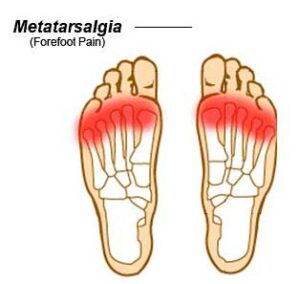
What is Forefoot Pain?

  • Forefoot pain refers to discomfort in the ball of the foot—the area just behind the toes. It can present as burning, stabbing, aching, tingling, or pressure pain. It may occur during walking, running, or even while at rest in severe cases.

  • This area of the foot handles a large portion of your body weight during motion, making it prone to overuse injuries, biomechanical stress, and structural changes.


Common Causes of Forefoot Pain

1. Metatarsalgia

General term for pain and inflammation in the ball of the foot.

Symptoms:

  • Feeling like you’re walking on a pebble

  • Pain worsens with activity or tight shoes

  • Can be due to poor foot mechanics, overuse, or fat pad loss


2. Morton’s Neuroma

A thickened nerve between the toes (usually between the 3rd and 4th toes).

Symptoms:

  • Sharp, burning pain or tingling

  • Numbness in toes

  • Feels like a lump or “sock bunched up” sensation


3. Plantar Plate Injury

A strain or tear in the ligament under the toe joint (often the 2nd toe).

Symptoms:

  • Pain at the base of the toe

  • Swelling or separation of toes

  • May lead to toe drifting upward or sideways


4. Sesamoiditis

Inflammation of two tiny bones beneath the big toe joint (sesamoids).

Symptoms:

  • Pain under the big toe, especially when pushing off

  • Tenderness beneath the joint

  • Common in dancers, runners, and people with high arches


5. Tailor’s Bunion

A bony bump on the outside of the foot at the base of the 5th toe.

Symptoms:

  • Redness, swelling, or a visible bump

  • Pain in tight shoes

  • Caused by genetics, pressure, or poor footwear


6. Freiberg’s Disease

Avascular necrosis of the second metatarsal head.

Symptoms:

  • Dull or sharp forefoot pain, swelling

  • Limited toe movement

  • Most common in teens or young adults


7. Capsulitis

Inflammation of the soft tissue surrounding the toe joint (usually 2nd toe).

Symptoms:

  • Pain under the ball of the foot

  • Swelling and tenderness

  • Feels like walking on a lump


8. Bursitis

Inflamed fluid-filled sacs under the ball of the foot.

Symptoms:

  • Localised swelling and pain

  • Often triggered by footwear or repetitive impact

  • May coexist with neuroma or arthritis


Risk Factors

  • High-impact activities (running, dancing, jumping)

  • Poor footwear (high heels, hard soles, narrow toe boxes)

  • Flat feet or high arches

  • Long second toe or bunions

  • Excess body weight

  • Previous injuries


Treatment Options

Our goal is to reduce pain, improve foot mechanics, and help you return to normal function.

Footwear Advice

  • Choose wide toe boxes, cushioned soles, and low heels

  • Avoid tight shoes, pointed shoes, and hard soles


Orthotics & Padding

  • Custom or prefabricated orthotics to redistribute pressure

  • Metatarsal pads or domes for neuroma, plantar plate, or capsulitis

  • Sesamoid offloading pads or cut-outs if sesamoiditis is present

  • Lateral forefoot support for tailor’s bunion


Activity Modification

  • Reduce high-impact activities

  • Switch to lower-load exercise (e.g., cycling, swimming)

  • Modify standing or walking routines if work-related


Manual Therapy & Exercises

  • Foot mobilisation

  • Calf, plantar fascia, and toe stretches

  • Strengthening of intrinsic foot muscles

  • Nerve gliding exercises (for neuroma)


Taping & Strapping

  • Support unstable toe joints

  • Offload inflamed or overstressed structures

  • Realign plantar plate or protect bunionettes


Icing & Anti-inflammatory Treatment

  • Ice the forefoot post-activity

  • Topical gels (Voltaren) or oral medication as advised by your GP


When Is Surgery Considered?

  • Surgical options may be considered when:

  • Conservative treatment has failed after 3–6 months

  • There is a tear, deformity, or persistent structural pain

  • You have advanced Morton’s neuroma, plantar plate rupture, or tailor’s bunion


Your podiatrist can refer you to a foot and ankle specialist if needed.


Prevention Tips

  • Replace worn-out footwear regularly

  • Avoid narrow or high-heeled shoes

  • Wear cushioning shoes on hard surfaces

  • Use orthotics if advised

  • Stretch and strengthen your feet regularly

  • Don’t ignore early signs of pain—it usually doesn’t go away on its own


When to Book In

You should see your podiatrist if you experience:

  • Burning, numbness, or tingling

  • Pain when walking or running

  • Swelling at the ball or side of your foot

  • Toe changes (lifting, drifting, or overlapping)

  • Difficulty fitting into shoes due to bunion or bunionette


Your feet carry you through life—let us help carry them through recovery.

Relieving pressure one step at a time.


From your team at Toe-tal Podiatry 


forefoot pain

Contact Us.

Please contact the appropriate location for bookings.

Salisbury Medical Centre
PH: 3277 1621 - Fax: 3277 2887

 ACE Sports Medicine – Hibiscus Sports Complex
PH: 3349 5733 - Fax: 3349 5122

 Acacia Ridge Day And Night Chemmart Pharmacy
PH: 3277 4220 - Fax: 3255 5644

 Brisbane Medical Specialists – Tarragindi
PH: 3184 0400 - Fax: 3892 7094

 Morningside General Practice Clinics – Morningside Plaza
PH: 3399 4685 - Fax: 3395 7377

Any other enquiries please email info@toetalpodiatry.com.au or call 0422 389 652